Ordering Clematis: Joy Creek Nursery

A Gloomy February Day in Seattle

A Gloomy February Day in Seattle

Weather here in Seattle has continued gray and drab, though day-length is noticably getting longer.  Take a look at the photo I just took from the back deck!   Gloom and doom.  Days like this are best spent armchair gardening (reading gardening books and seed catalogues) or computer gardening (surfing the net for garden ideas or plants to buy).

Personally, I opted to drool over my favorite online mail-order nurseries, especially those that carry oodles of clematis.  I zeroed in on Joy Creek Nursery

Maurice Horn, co-owner of Joy Creek Nursery, is very knowledgable about clematis.  I once had the privilege of hearing him give a fascinating talk about the history of how clematis came into the horticultural world from the wild, including stories of some of the characters who hunted plants and brought them to Europe, and how some of the first hybrids, like Clematis Jackmanii, came into being.  As a result of strong connections to current Japanese clematis hybridizers, Maurice has access to many unusual and beautiful clematis, including little beauties with small bell-shaped flowers.
Joy Creek Nursery

Joy Creek Nursery

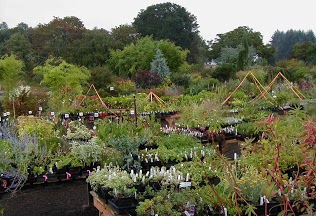
One HUGE advantage of Joy Creek Nursery over some of the other mail-order nurseries is that one can actually go there in person as well as order online or via telephone.  The nursery, which  is open seven days a week from March through October, sells hordes of plants and has truly fabulous display gardens where visitors can see how plants grow and combine with each other, including many clematis.  Joy Creek also runs a Sunday lecture series throughout the summer.  They are located in Scapoose, Oregon, on the Columbia River north of Portland. (Photo from Joy Creek Nursery.)

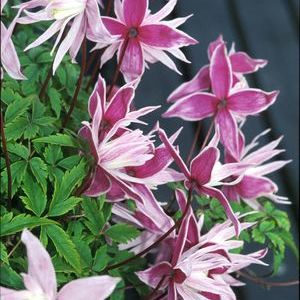
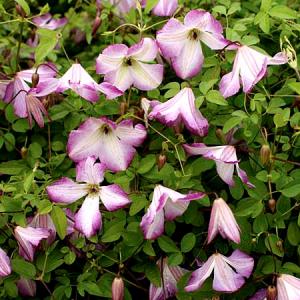
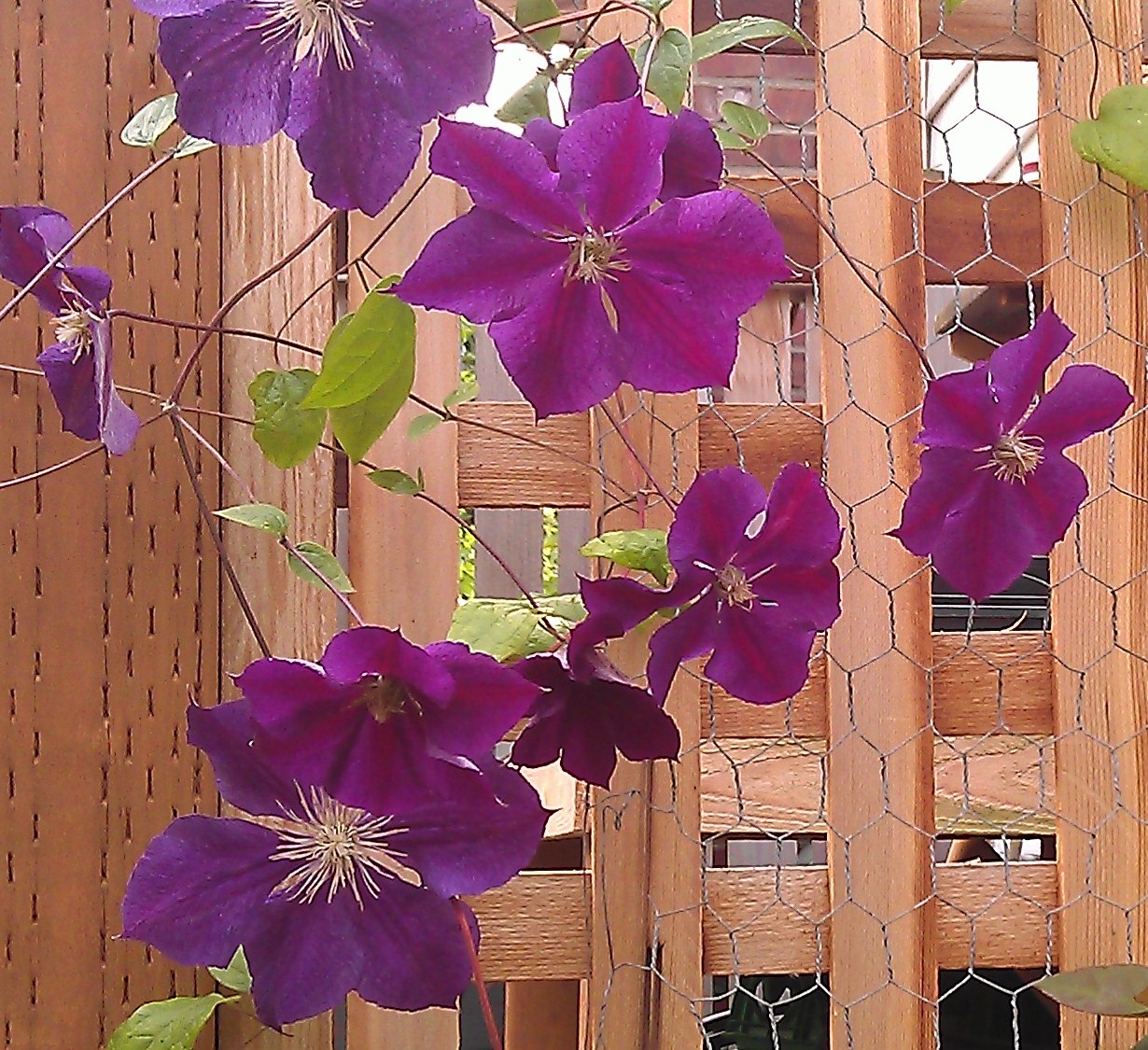
But back to my mail ordering.  The many plants I’ve gotten from Joy Creek over the years, whether mail-ordered or purchased in person, have always grown healthy, strong, and beautiful.  Below are photos of two, Clematis Bijou (a ground cover clematis from British hybridizer Raymond Evison) and Clematis Shizuki (one of the Japanese hybrids with a blue-violet bell crisply outlined in white that blooms all summer in a pot on my deck).   This year, I ordered two more clematis from Joy Creek Nursery–Clematis Kahori no Kimi and Clematis Princess Red.  Both have flowers in the form of pinkish-red nodding bells, and Kahori no Kimi is said to have the additional enhancement of a citris scent.  I notice Princess Red no longer shows up on their website.  Yikes!  I hope they didn’t run out before they put my order through! 

Clematis Shizuki

Clematis Shizuki

Clematis Bijou, a ground-cover clematis
Clematis Bijou, a ground-cover clematis
Ordering Clematis: Silver Star Vinery

Plants under Glass at the Conservatory

Plants under Glass at the Conservatory

Yesterday, after a nice leisurely Sunday breakfast out, my husband and I found ourselves near the Volunteer Park in Seattle with its beautiful old glass conservatory. All the grey foggy days we’ve had around here of late made us hanker for live plants and color, so we stopped by.

Seeing beautiful foliage and lush blooming plants put me in the mood to think about clematis (unfortunatley, there weren’t any in the conservatory).  When I got home I spent some serious time perusing the websites of my three favorite mail-order clematis nurseries in the US and day-dreaming about which new clematis I wanted to grace my garden.  Most years I buy at least a couple of clematis  from each one of these great nurseries.  I know, I know, where will I put them all you ask?!  Don’t worry, I always find a way–I have a big shoehorn just for this purpose. 

Clematis Star of India

Clematis Star of India

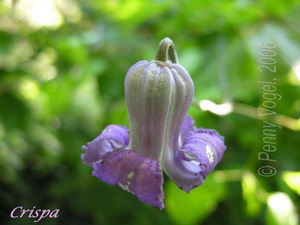
Today I will  tell you about Silver Star Vinery, which is located in the foothills of the Cascades near Vancouver, Washington.  This mail-order-only nursery offers a wide variety of well-established, healthy clematis.  Owner, Debbie Fisher, has strong connections with many European hybridizers and imports a few new cultivars almost every year.   Her big healthy plants tend to get going quickly.   Before she ships, she usually sends her customers an email telling them to go dig the holes cuz she’s heading to the post office!  I bought Clematis Star of India from her last spring and by July this saftig young plant had at least 25 beautiful flowers on it — and I’d had it less that six months!  Check out my photo.

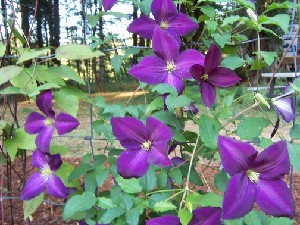
So, after looking, and thinking, and making lists, and looking some more, I placed an order yesterday with Silver Star Vinery — below as a little teaser are just two of them.  (Please note:  I have permission from Silver Star Vinery to use photos from its website in my blog.)

Check back in a couple of days — I’ll tell you about Joy Creek Nursery and what I ordered from there.

Clematis crispa, a sweet little fragrant bell!

Clematis crispa, a sweet little fragrant bell!

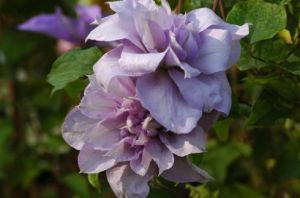
A new Jackmannii -- Jackmanii purpurea.  Debbie says it's VERY floriferous!

A new Jackmannii — Jackmanii purpurea. Debbie says it’s VERY floriferous!

Clematis Pruning, Part 1

Don't we wish?!

Don’t we wish?!

In the depths of this Seattle winter, the wet, wet, and more wet has metamophosed many plants into black slime.  Deeeee-skusting!   Serious garden clean up is in order.  But, wait — even more important to a clemaniac like myself, with 130 clematis out there, is to begin pruning . 

The Three Pruning Groups for Clematis

From late fall to early winter, I work on clematis that have their main flush of blooms  in July, August, and September, like the Clematis Abundance on the right, showing off in July.  These clematis are in Pruning Group C or 3.  They bloom on new wood (that is, new vine), so they can be cut back hard without affecting next summer’s bloom.  They will bloom only on the new vines that grow in spring and summer. 

But don’t hard-prune spring-blooming clematis, like C. montana, C. armandii (the evergreen clematis), and C. alpina, for instance, which are in Pruning Group A or 1.  They can be pruned in late spring after they have finished their show. 

And we have to wait a couple of months yet til late February or March, depending on the weather, before we can prune those luscious large-flowered beauties that have their main bloom time in May and June — they are in Pruning Group B or 2.  That’s because these clematis bloom on old vines, on which they already formed their blooms last summer or fall.  If pruned hard now, most or all of the blooms for the year will be lost.  Instead, wait a bit longer to prune them, and then,  only lightly  — I’ll be sure to show you how when the time comes. 

Clematis in Winter

Clematis in Winter

The Nitty-Gritty of Pruning Summer Bloomers

Back to my recent pruning.  Here’s C. ‘Abundance’ again, this time showing their winter charms — NOT.  And right by the front door, too.  I pruned both C. ‘Abundance’ and the one in the window box next to it back hard (down to 1-3 feet)  just before Christmas.  Sounds drastic, but worry not — they will come roaring back in the summer.  And now I’m not subjected to  those ugly dead leaves for the rest of the winter.   Check the after photo below–looks better,eh?  Especially after I covered the window boxes with greens and all my gazing globes for a holiday effect.  Turns out this treatment has the added bonus of helping marginally hardy plants in my window boxes, like begonia, flowering maple (abutilon), million bells, and others, survive the winter and give me a head start in the spring!

That's better.

That’s better.

Here’s the how-to of pruning these great summer bloomers in Pruning Group C or 3.  We call it the pony-tail cut.  Find your pruner, put on your gloves, and head outside.   Look for a likely summer-blooming pruning candidate .  Grab a handful of vines in one hand and whack them off 1-3′ from the ground with your pruners.  If the plant is large with many vines, several pony-tail cuts may be in order.  Then put all that dead mess in the yard waste.  Easy!  So easy, in fact, that a child can do it!  See my Clematis Negrityanka below blooming away last July.  Then look at it in November.  Yuch.  As you can see from the series of photos below, my young friend Tessa grabbed the vines in her left hand like a pony tail and cut them back hard with the pruner in  her right.  Easy as pie!

C. 'Negrityanka' in July

C. ‘Negrityanka’ in July

C. 'Negrityanka' in November

C. ‘Negrityanka’ in November


                What a difference

             a few months makes!


Tessa grabs the vines in her left hand and cuts them with her right.

Tessa grabs the vines in her left hand and cuts them with her right.

Ta DAAA!

Ta DAAA!

Clematis Blooming in December

A very late and a bit tattered C. 'Duchess of Edinburgh'

Clematis in my garden have been showing no signs of entrancing me with blooms in December.  Then the other day I thought to look up.  There, about 10′ off the ground up the gutter, Clematis ‘Duchess of Edinburgh’, a double June bloomer that sometimes reblooms with single flowers, had opened a somewhat tattered white flower, with second one on the way — maybe we’ll see that one in January.  I had to  hang out an upstairs window to get the photo.   What a delightful surprise at the end of December! 

Two other clematis I have are supposed to bloom in November and December, Clematis cirrhosa ‘Freckles’ (see photo below) and Clematis cirrhosa ‘Jingle Bells’.  Jingle Bells, which is said to sport white bells in late fall/early winter, at least has the excuse of having been in the ground only a little over a year.  Freckles, on the other hand, was planted in 2008 and has no such saving grace.  My plant, which should bloom in late autumn, tends to throw a few blooms in July or August, then nothing in the fall.  Though it’s evergreen with dainty fresh green leaves throughout the winter, I hanker for the flowers!  In the photo below, my C. ‘Freckles’ demonstrates its disdain for bloom times by showing off with my Barberry ‘Helmond Pillar’ and Irish Bells in July!  Geesh.  You can see why it was named ‘Freckles’, though. I guess there’s still time — both Jingle Bells and Freckles are said to bloom from late fall through February. We’ll see.

Cirrhosa freckles

Planted 6 More!

Now all my clematis are in the ground! Yippee!  I managed to plant the last six between downpours a few days before Christmas. 

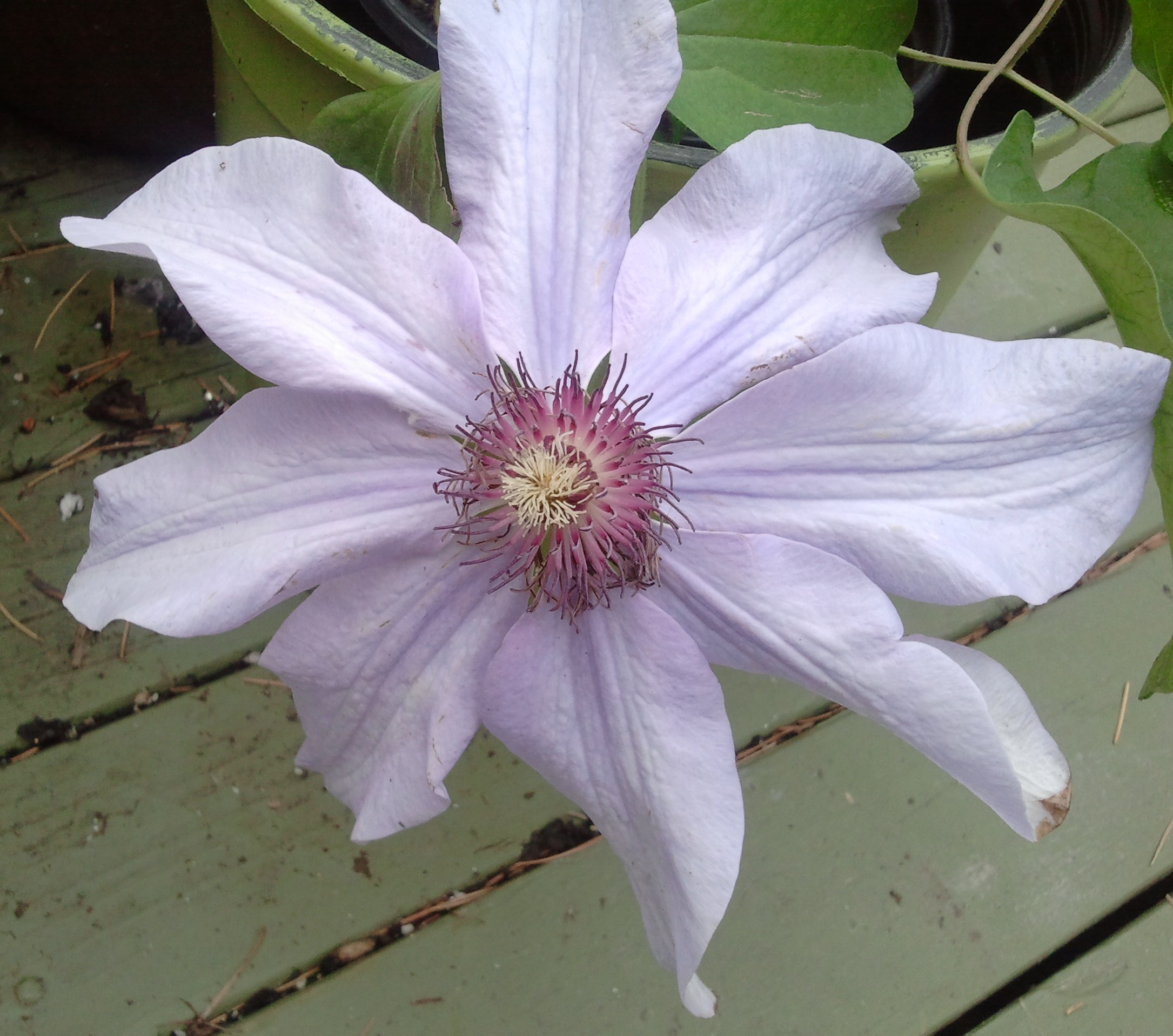
One of them, Clematis Rhapsody, is obviously misnamed.  When I bought it late last spring — the flowers were HUGE and the bloom was a luscious light mauve with a reddish boss.  I simply couldn’t resist. But in the process of planting it the other day, between a dwarf Pieris and a variegated Fatsia along a fence, I looked it up on Clematis on the Web on my smartphone to see what exposure it needed.  Lo and behold, I realized that my plant is certainly NOT Clematis Rhapsody.  The first photo below is of my clematis blooming in its pot last June.  The other photo is the real Clematis Rhapsody–deep purple with a white boss.  Hrmph.  Unfortunately, this problem of misnamed clematis is not an uncommon occurence.   If you can identify my lovely unknown clematis — please let me know!


My Plant that is supposedly C. Rhapsody'

My Plant that is supposedly C.
Rhapsody’

The Real Clematis Rhapsody
The Real C. ‘Rhapsody’

The other five clematis I recently planted are listed below with links to photos and descriptions on that fabulous website, Clematis on the Web.  This website has incredible information and usually photos of thousands of clematis!  I can spend hours diddling around there.  I also use it when I’m at nurseries to look up a particular clematis.  I can find out how the blooms look, when it will bloom, how to prune it, and lots more.

Clematis The First Lady, an American clematis

Clematis Jan Fopma, a clematis that lounges rather than climbs

Clematis Bagatelle

 Clematis Etoile de Malicorne

Clematis florida sieboldiana, a second one because I love it so much

Now that all my clematis are planted (except for three that are still to small to be planted out), I guess I’ll peruse my favorite mail-order clematis nurseries.  I’ll be telling you more about them later.

Planted Three Clematis (C. ‘Louise Rowe’, C. ‘I Am Lady Q’, and C. alpina ‘Markham’s Pink)

C. alpina 'Markham's Pink'

C. alpina ‘Markham’s Pink’

Events both at home and at work have conspired to give me little time in the past three weeks for contemplating clematis, let alone doing anything with them or writing about them.  Things have let up a bit now, thank goodness.

I did manage to get three of my clematis planted between raindrops, only seven more to go.   (For tips on planting a clematis, click on the Buying and Planting Clematis category on the left.) To learn how to plant a clematis, see my earlier post.)  The first to go in the ground was C. alpina ‘Markham’s Pink.’   It is snugged up to an Azara, a narrow evergreen shrub or small tree with tiny dark green leaves.  I think the two will look stunning together when ‘Markham’s Pink’ blooms in April. 

This clem was hybridized by Ernest Markham, a British clematis enthusiast for more than 35 years in the early half of the twentieth century.  He and his employer and friend, William Robinson, took on many clematis from a prolific French hybridizer, Fransique Morel, when Morel lost interest in clematis.  As a result, we can grow many of Morel’s beautiful clematis today.  Here’s a list of the beautiful Morel clematis I grow–I am sure you will be seeing them in future posts, and perhaps you grow some of them yourself:  ‘Abundance’, ‘Comtesse de Bouchaud’, ‘Etoile Violette’, ‘Gravetye Beauty’, ‘Huldine’, ‘Little Nell’, ‘Madame Julia Correvon’, ‘Minuet’, ‘Perle d’Azur’, ‘Purpurea Plena Elegans’, and ‘Ville de Lyon’. 

C. 'Louise Rowe'

C. ‘Louise Rowe’

Next I tucked a specimen of C. ‘Louise Rowe’ into the ground near both Rosa ‘Jude the Obscure’, a soft yellow David Austin climber, and a Choisea ternata, or Mexican Orange, which is an evergreen shrub with fragrant white flowers in early summer. 

This beautiful clematis sports pale mauve satiny double flowers in spring (May/June), then semi-double and single flowers later.   All three types of blooms can be on the vine at one time.  I’ve hankered for this clematis for some time and can’t wait to see it bloom with the round cabbage form of the yellow rose.  It will also look gorgeous draped over the Choisea.  I’ll be sure to post photos.

C. 'I Am Lady Q'

C. ‘I Am Lady Q’

Seems that I was in a pink-mauve mood when I recently planted clematis.   C. ‘I Am Lady Q’  is a lovely and prolific bloomer with nodding bi-color flowers in white and lavendar that blooms in high summer (July/August).  It was hybridized by Wim Snoeijer of Van Zoest nursery in The Netherlands.  I have the privilege of knowing Wim, who is a prolific producer of great clematis.   I chose to give ‘I Am Lady Q’ a home in a perennial bed in front of my deck where it can frolic with C. ‘Princess Diana’ (pink) and C. ‘Blekitny Aniol’, or ‘Blue Angel’ (light blue).

The weather looks fairly decent this afternoon, so I’d better get out there and dig some holes for all the poor clems still in pots!

Collecting Clematis Seed

C. 'Sonnette'

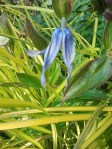
Three clematis in my garden tempted me to collect seed this fall:   a sweet pink bell (Clematis Sonnette), a light blue little nonclimbing clematis (integrifolia type) from the Rogerson Clematis Collection (Clematis Skylark), and a species clematis (C. viorna) with small urn-shaped flowers in lavender and white (C. viorna). 

C. integrifolia ‘Skylark’

Growing clematis from seed tickles the imagination.  The anticipation is great, waiting first for the seed to sprout and then for it finally to bloom.  What color will the flower be?  What shape?  Will it be fragrant or have great seed heads?  You just never know til you see it.  Even the most careful of hybridizers can be surprised by the result of a carefully planned cross between two different clematis.  

C. viorna

I am a novice at starting clematis from seed.  My first foray into the process came into being when the British Clematis Society sent me seed in 2011 as a reward for joining .  Those first seedlings are growing well, but none have bloomed yet.  Since then I have also started seeds received from friends, the Rogerson Clematis Collection, and the International Clematis Society, as well as seeds harvested in my own garden.   One caveat about growing clematis from seed:  it can be a long process — not for the impatient.  Some seeds can take as much as three years to sprout; others as little as six months.

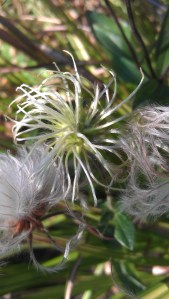
Seedheads from C. integrifolia ‘Skylark’

Today’s subject is about the first step in seed starting — collecting seed.   To be viable, clematis seeds need to be brown (not green) and should look as though they may drop any minute.  In the photo on the right, the seedhead in the middle is still too green and its feathery tails are not fluffy enough to harvest yet.  But take a look at the seedhead to the left and below it — seeds are brown with fluffy feathers and ready to be picked.  Some clematis have very long feathery tails like those in the photo (from C. ‘Skylark’) and others have much shorter tails that don’t fluff up so much.   Seeds can be large like C. viorna (below) — about 1/4 – 1/2 inch wide.  Others are smaller, but still visible.  If you don’t see any seeds in the fluff, there probably aren’t any.  Go out into your garden with a container or a baggie and check your clematis for viable seeds.  If you find seed, pull the whole seed head off with your fingers and drop it into a container.  Be sure to have a separate container for each plant from which you harvest.

Back indoors, dump the seeds, tails and all, on a plate or paper towel.  What a treasure trove of possibilities!  I take the time to pull the feathery tail off each seed.  This step allows me to get a better idea of just how many seeds I have, but is not required for successful germination.  

To the left are the C. viorna seeds prior to cleaning (removing the tails).  The purpose of these feathery tails is to help the clematis drift in the air and land, perhaps, a bit far from its mother.  But they are certainly not needed when planting seed in pots.  Below is the same set of seeds, minus their tails. 

Since recent Seattle weather has been wet, I will allow the seeds to really dry out on a paper towel on top of the refrigerator for a few days. 

C. viorna seeds after removing tails.

When I feel sure the seeds are dry, I will pour them into glycene or paper seed bags and place the bags in a glass jar with a tight-fitting lid and put it  in the fridge.  I also put one or two of the dehydration packets from old vitamin bottles inside to help keep the seeds dry.  Some clematis seed require a cold time prior to germination, so I just put them all in cold storage for a few months.  In spring I will plant them in seed starter mix and leave them outside to their own devices.  This process works well for me so far. 

But if you have a greenhouse or an inside seed starting area with enough light and warmth, you could pot some of your seed up and wait and watch all winter to see that first little tiny bright green leaf that will lighten your heart and bring a big smile to your face.  If you decide to start yours now, here is a link to a great website that goes into the nitty gritty of starting clematis from seed:  http://www.bcollingwood.com/index1.htm .  Otherwise, like me, wait til spring, when I will show you how I start my seeds.

Clematis Blooming in November

Believe it or not,  several Clematis are blooming in my November garden.  Sweet Autumn Clematis and Madame Baron Veillard (mentioned in a previous post) are still blooming, though they are both beginning to wind down.  My lovely yellow-belled Clematis otophora (see last post) is also still showing off  its eye-catching blooms.  What a beautiful clematis!

C. ‘Cezanne’

I have a few summer-blooming clematis throwing a late bloom or two.  Among those are Clematis ‘Cezanne’, with a soft mauve-blue flower.  This is one of Raymond Evison’s patio clematis, bred to grow to only 4-6′ tall, be very floriferous, and have a long bloom-time.  C. ‘Cezanne’ blooms in a large window box for me and has several flushes of bloom throughout the summer.  I think this one will be the last for this year.

C. ‘Caroline’

Clematis Caroline is a June bloomer with soft pink flowers.  If you cut these June bloomers back by about 1/3 after their first heavy bloom, many of them (not all) will repeat bloom in the late summer or fall, though usually with smaller flowers.  I cut C. Caroline back about a third in early July and was rewarded with another flush in September.  This bloom is particularly late. 

C. ‘Duchess of Edinburgh’

A double June bloomer, Clematis Duchess of Edinburgh, is also giving me a show in November.  Like C. Caroline, I cut the Duchess back a third in early July and now it’s got two smaller single blooms and two buds.  I hope the buds make it through the cold spell we are expecting (maybe down to the mid thirties tonight — brrrrr). 

I want to show you two more clematis (see photos below).   My young (first year) Clematis Jackmanii on the left has been blooming steadily since early July and still has this one bloom left.  I don’t think I have ever had such a young clematis bloom so heartily in its first year.  But this is the famous C. Jackmanii, the first large-flowered hybrid clematis, which came into being in the late 1850s.  It’s proven itself over time and is, I believe, the most popular clematis ever.  The second clematis below is a new potted C. florida sieboldii.  I like my first one so much that when I saw another recently in a nursery, I snapped it up — and this one is still blooming.

C. florida sieboldii

I was hoping to be able to show you flowers on my November/December bloomers, Clematis cirrhosa ‘Freckles’ and Clematis Cirrhosa ‘Jingle Bells’, but not to be.   They may well be in bloom next month, though, so stay tuned.

Activities I will be engaged in soon (in addition to trying to get 10 more clematis in the ground)  are gathering seeds and cutting a few of the July-August bloomers back hard.

WOW! Species Clematis otophora Blooming in My Garden!

In bud a couple of weeks ago

Last spring I purchased a healthy Clematis otophora, which is said to sport yellow bells,  and planted it to grow on an Acer griseum (paperbark maple).  I know very little about this plant, but it grew  and grew.  Even so, I never expected it to bloom in the first year (first six months, really).  Just a couple of weeks ago I was thrilled to see buds (see photo), but I wasn’t sure whether they’d have time open before frost.  

Then on Saturday I found blooms — the most lovely yellow bells!  See photo below.  There seems to be very little information about this rare clematis from the mountains of Sichuan in China.  I am hoping against hope that it is hardy here in the Pacific Northwest because it looks so happy, I simply can’t bear to move it. 

Beautiful Yellow Bells

Clematis otophora was sold to me by Far Reaches Farm in Port Townsend, Washington.  We here in the Northwest are fortunate to have this nursery because the enthusiastic proprieters, Kelly Dodson and Sue Milliken, are plant nerds extraordinaire and thoughtful plant explorers.   In fact, they are on a plant exploration right now, in China, I believe.  You can visit Far Reaches Farm online at:  http://www.farreachesfarm.com .  They offer many plants via mail order and have special open days for visiting the nursery.  They specialize in unusual plants, including a few rare clematis.  For example, this August when I visited the nursery in person, I was able to buy two additional unusual clematis, Clematis tibetana (the black form) and Clematis repens.  These two plants are young yet and still in pots — I may get them in the ground next spring; if not, then next fall.  If you happen know anything more about any of my three new unusual clematis (Clematis otophora, Clematis repens, or Clematis tibetana (black form)), please, please let me know!!!

See below for photos of Clematis tibetana (black form) and Clematis repens.


Dangling Bells of Clematis repens

Dangling Bells of Clematis repens


The Dusky Bells of the Black Tibetana

The Dusky Bells of the Black Tibetana

Planting a Clematis

Sunny SKy

Beautiful Blue Sunny Sky

Do you have a clematis to plant this fall?  If not, you still have time to scour the nurseries for a likely specimen (see my recent post on how to choose a nursery clematis in the fall). 

Yesterday, I planted a nursery plant myself, so let me show you how I did it.   Sometime last summer, I purchased Clematis Sunny Sky (see photo right) from a nursery that had all its clematis out in full sun, which is very hard on clematis still in pots.  This one looked really cooked,  but I used my smart phone to look it up on Clematis on the Web.   I found that it is a vigorous and floriferous clematis that will grow to about 4 – 6 feet tall  and needs full sun, so of course I took it home.   Below are the steps I followed to plant it.

1.  Find a suitable spot to plant the clematis.  I walked around my garden and found a sunny spot where I thought this clematis could add some pizazz near a yellow rose (Rosa ‘Jude the Obscure’)–they should make a charming pairing.

2.  Soak the clematis.  The easiest way is to fill a bucket with water and plunk the clematis in — pot and all — while you dig the hole. 

3.  Dig a large hole. Make the hole as big as you can–some say at least 2′ x 2′, but that’s a honking big hole that we can’t always fit into our gardens.  But do try to make the hole at least twice as deep and twice as wide as the pot.  See my hole to the right–it’s about 18″ deep and 15″ wide. 

4.  Fill hole with water and let drain out.  This serves two purposes:  it lets you know how fast the area drains and it hydrates the soil down deep.   If the water drains so fast you can’t even fill the hole or if it drains out just in a few minutes, the drainage is probably too fast for most clematis.  If it takes more than two or three hours to drain, it’s probably too slow.   When I dug this hole, the bottom 12 inches of soil were still fairly dry from our summer drought, so I filled it twice.  The water drained in about 20 minutes both times.

5.  Plant the Clematis.  First, I put 2″ of manure (usually fresh or composted steer manure) in the bottom of the hole (a jolt of food for the clematis two or three years down the road).  I covered that with about 2″ of native soil mixed with compost.  Before removing a clematis from its pot, first remove any bamboo or stick stapled to the side of the pot.  Otherwise, getting the plant out of the pot can be a struggle.   Set the plant in the hole so that the crown is level with or just below the soil level.  If the plant is too low, take it out and add more soil to the hole.  If it’s too high, either remove some soil from the hole or loosen the roots on the bottom of the plant and remove some of that soil.  Once the plant is at the right height in the hole, fill in with a mixture of native soil and compost — I also like to ad a little alphalfa meal and bone meal.  Tamp down and water.

6.  Final Touches.  Cover the soil around the plant with at least 2″ of compost.  Cut the plant back to 6 – 12″ tall to encourage root growth over the winter.  I plan for C. ‘Sunny Sky’ to weave through the shrubs around it.  This particular clematis does not climb–rather it lounges about on whatever support it can find or it sprawls on the ground.  I inserted a small bamboo stick into the hole, to which I can tie the clematis to as it grows and, hopefully, guide it to the shrub in which I want it to lounge.  Once it reaches the shrub, it’s on its own. If yours is a climber that you want to ascend a structure, you must also put something in the hole to give it a leg up onto its new support.  The support structure should be in place when you plant, if at all possible.  Make sure that the support (such as a trellis, arbor, or fence) has skinny bits — no thicker than your little finger — for your climber to cling to.  If your support does not have anything thin enough, you can attach chicken wire, string, or some other thin thing to it.

I’ll post photos of C. ‘Sunny Sky’ when it blooms next summer.  Send me photos of yours, too!

« Older entries Newer entries »