February Bloomer: Clematis cirrhosa var purpurascens Freckles

Winter-Blooming Clematis Freckles

Winter-Blooming Clematis Freckles

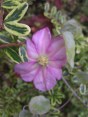
Yes, I truly do have a clematis actually blooming in Seattle in February! Clematis cirrhosa var purpurascens ‘Freckles’ (that’s its full name–really, it is!) is presently gracing my garden with blooms, well, one anyway.  The blossom I gleefully discovered two days ago was found only because I leaned half over the deck checking out my vines hoping against hope for a bloom. Then–aHA–I saw one! And almost killed myself in my excitement by leaning just a tad too far over the deck rail before I came to my senses. Alas, today when I wanted to photograph it for posterity, it had already shriveled.  Nearby buddies were still only small white buds. I certainly didn’t want to disappoint readers, especially Ingrid in Sweden, who were hankering to see a clematis actually blooming now in a garden real time. So, this morning I hunted around and right on the deck in easy reach of the camera, what to my wondering eyes should appear, but a lovely single bloom. 

The fresh-looking crisp  foliage of this clematis is dainty, apple-green, and deeply divided, almost fernlike.  Even when it’s not blooming it adds welcome green accents to the winter garden. 

Cirrhosa Freckles in July

Cirrhosa Freckles in July

The down-side is that this clematis, and all its Clematis cirrhosa cousins, are tender, being natives of the Mediterranean, from southern Spain and northern Africa to Syria.  Luckily, here in Seattle, we can grow them easily.   This particular clematis was raised from seed collected on Mallorca (an island in the Mediterranean Sea) by Allen Peterson, curator of the Chelsea Physic Garden in the 1980s.  Well-known clematis nurseryman, Raymond Evison, received seeds from Peterson and introduced one of the resulting seedlings as Freckles in honor the freckled face of one of his daughters.

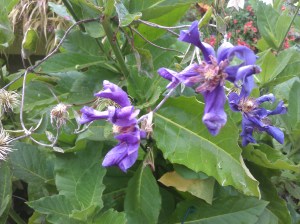
A sun-loving vine that can grow 12 – 15′, Clematis Freckles is expected to bloom betweeen October and February.  My particular plant is confused–or maybe just a rebel.  This year it bloomed with strong red freckles in July with my burgundy Barberry ‘Helmut’s Pillar’ and the chartreuse flowers of Bells of Ireland — then again now in very late February with a pallid flower, whose wan look is due I presume to the short gray days we’ve had, which lacked enough sun to bring out strong color.

If you have one, let us know how yours behaves (or misbehaves).

Clematis Blooming in December

A very late and a bit tattered C. 'Duchess of Edinburgh'

Clematis in my garden have been showing no signs of entrancing me with blooms in December.  Then the other day I thought to look up.  There, about 10′ off the ground up the gutter, Clematis ‘Duchess of Edinburgh’, a double June bloomer that sometimes reblooms with single flowers, had opened a somewhat tattered white flower, with second one on the way — maybe we’ll see that one in January.  I had to  hang out an upstairs window to get the photo.   What a delightful surprise at the end of December! 

Two other clematis I have are supposed to bloom in November and December, Clematis cirrhosa ‘Freckles’ (see photo below) and Clematis cirrhosa ‘Jingle Bells’.  Jingle Bells, which is said to sport white bells in late fall/early winter, at least has the excuse of having been in the ground only a little over a year.  Freckles, on the other hand, was planted in 2008 and has no such saving grace.  My plant, which should bloom in late autumn, tends to throw a few blooms in July or August, then nothing in the fall.  Though it’s evergreen with dainty fresh green leaves throughout the winter, I hanker for the flowers!  In the photo below, my C. ‘Freckles’ demonstrates its disdain for bloom times by showing off with my Barberry ‘Helmond Pillar’ and Irish Bells in July!  Geesh.  You can see why it was named ‘Freckles’, though. I guess there’s still time — both Jingle Bells and Freckles are said to bloom from late fall through February. We’ll see.

Cirrhosa freckles

Clematis Blooming in November

Believe it or not,  several Clematis are blooming in my November garden.  Sweet Autumn Clematis and Madame Baron Veillard (mentioned in a previous post) are still blooming, though they are both beginning to wind down.  My lovely yellow-belled Clematis otophora (see last post) is also still showing off  its eye-catching blooms.  What a beautiful clematis!

C. ‘Cezanne’

I have a few summer-blooming clematis throwing a late bloom or two.  Among those are Clematis ‘Cezanne’, with a soft mauve-blue flower.  This is one of Raymond Evison’s patio clematis, bred to grow to only 4-6′ tall, be very floriferous, and have a long bloom-time.  C. ‘Cezanne’ blooms in a large window box for me and has several flushes of bloom throughout the summer.  I think this one will be the last for this year.

C. ‘Caroline’

Clematis Caroline is a June bloomer with soft pink flowers.  If you cut these June bloomers back by about 1/3 after their first heavy bloom, many of them (not all) will repeat bloom in the late summer or fall, though usually with smaller flowers.  I cut C. Caroline back about a third in early July and was rewarded with another flush in September.  This bloom is particularly late. 

C. ‘Duchess of Edinburgh’

A double June bloomer, Clematis Duchess of Edinburgh, is also giving me a show in November.  Like C. Caroline, I cut the Duchess back a third in early July and now it’s got two smaller single blooms and two buds.  I hope the buds make it through the cold spell we are expecting (maybe down to the mid thirties tonight — brrrrr). 

I want to show you two more clematis (see photos below).   My young (first year) Clematis Jackmanii on the left has been blooming steadily since early July and still has this one bloom left.  I don’t think I have ever had such a young clematis bloom so heartily in its first year.  But this is the famous C. Jackmanii, the first large-flowered hybrid clematis, which came into being in the late 1850s.  It’s proven itself over time and is, I believe, the most popular clematis ever.  The second clematis below is a new potted C. florida sieboldii.  I like my first one so much that when I saw another recently in a nursery, I snapped it up — and this one is still blooming.

C. florida sieboldii

I was hoping to be able to show you flowers on my November/December bloomers, Clematis cirrhosa ‘Freckles’ and Clematis Cirrhosa ‘Jingle Bells’, but not to be.   They may well be in bloom next month, though, so stay tuned.

Activities I will be engaged in soon (in addition to trying to get 10 more clematis in the ground)  are gathering seeds and cutting a few of the July-August bloomers back hard.

Clematis Blooming in October

Did you know that our mild Pacific Northwest climate allows for at least one clematis to be blooming in every month of the year?  Here’s a taste of what I mean.  In my October garden, I have two late-blooming clematis at their peak of bloom, Sweet Autumn Clematis (C. terniflora) and C. ‘Madame Baron Veillard’.

Sweet Autumn Clematis in October

Sweet Autumn Clematis is a big plant (20-30 feet) with a multitude of small white wonderfully fragrant flowers.  In our climate this plant blooms in October, though in my Boston garden it bloomed for me in August and September. To be successful in the Pacific Northwest, this clematis needs to be sited in a warm spot.  That’s because the flowers require serious heat to set buds and shortening days to trigger them to open.  We don’t have any trouble providing the shortening days, but heat units can be a problem here.  Mine seems to love growing eight feet up a lattice onto a west-facing deck.

Clematis ‘Madame Baron Veillard’ is a lovely mauve flowered clematis that waits til September to even think about blooming in my garden.  It was named over 100 years ago for a French baroness who loved to garden. 

As you can see, it has a lovely  bloom that warms the heart just as the days seem to be getting shorter and gloomier.

Several other clematis are blooming in my garden now, including three that are especially showy.  The one on the right is Clematis ‘Sizaia Ptitsa’  — that’ll twist your tongue, huh?  A friend of mine just calls it Slice of Pizza, which is not too far off the Russian pronunciation.  This clematis has been blooming for over three months and is just beginning to show signs of winding down. 

Below is Clematis viorna, a species from the southeastern US with a sweet bell-shaped cream-and-lavendar bloom and wonderful seed heads.  It, too, has been blooming for months and is showing off here with the lavendar berries of a beauty berry.  Last, but definitely not least, is Clematis florida ‘Sieboldii’ (also below) – what a gorgeous flower!

C. viorna (species clematis)

Newer entries »